

 Click to Call
 Send us a Text
 Get Directions
Why Plumbing Carries Big Insurance Risks—And Why It Matters to Your Bottom Line
Chicago plumber insurance comes with some of the toughest challenges in the trades. It’s not just about injuries on the job. It’s about the damage your work can cause if something goes wrong.
A burst pipe. A missed shutoff valve. A ruptured line during installation. Any of these can mean $50,000 in water damage to a customer’s home or office. That’s not a claim. That’s a catastrophe.
Plumbers also work in tight spaces: basements, crawl spaces, and roofs. That means fall risks and back injuries happen every day. It’s why carriers treat plumbing as a higher-risk trade.
Here’s the reality: You need two separate insurance programs. Workers’ compensation covers your crew when someone gets hurt. Commercial auto covers your fleet when an accident happens between jobs. Ignore either one, and a single claim can wipe out your profit for the year.
Let’s break down what you actually need.
Chicago plumber insurance: what your auto policy should include
Your commercial auto program must address three specific risks in plumbing work:
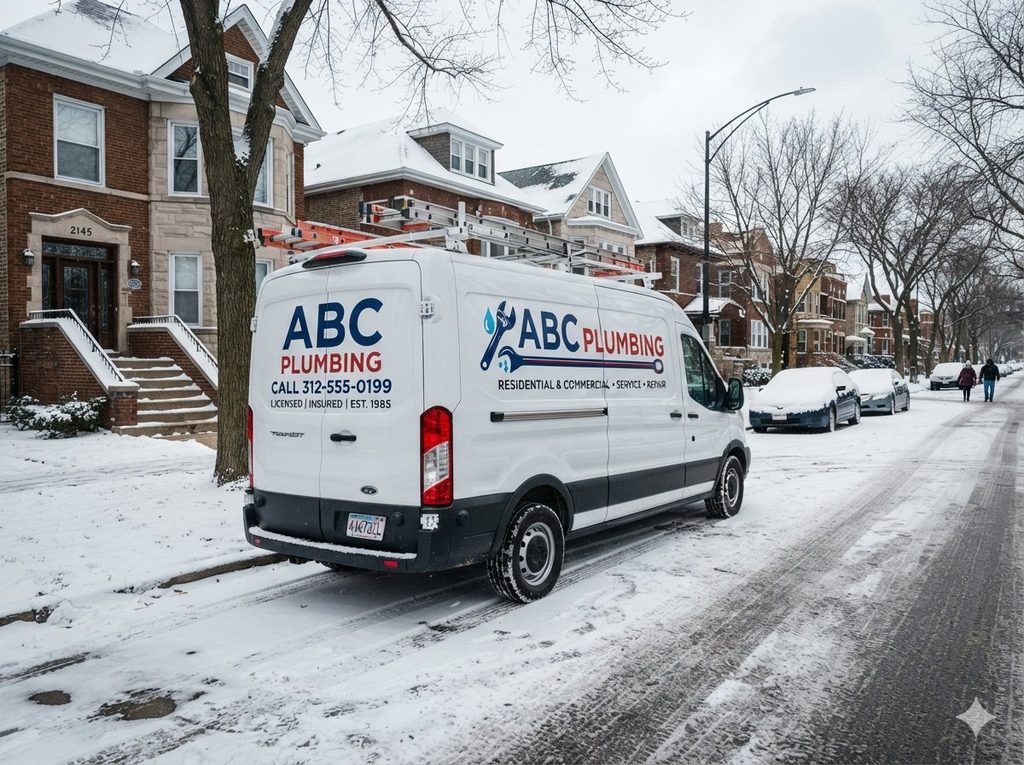
Your service trucks and vans
Your fleet is on the road constantly, between emergency calls, supply runs, and scheduled jobs. So you need comprehensive and collision coverage, plus auto liability and medical payments coverage. In addition, Chicago’s winter weather makes uninsured motorist coverage essential.
Why? Because Chicago drivers don’t always carry adequate insurance. A rear-end collision in your service van costs thousands—not just in vehicle repair, but in lost service days and equipment damage.
Hired and non-owned auto coverage (HNOA)
Most plumbers miss this one. Here’s the situation: A technician uses their personal pickup to grab supplies from the wholesale distributor. A subcontractor shows up in their own van for emergency work. An accident happens.
Who’s liable? You are.
HNOA coverage protects you when employees or subcontractors use personal vehicles for business. Ask for it explicitly. Many carriers don’t include it automatically. This is one of the most critical gaps we see in plumber policies—don’t be caught without it.
Liability limits that match your market
General contractors and property managers expect plumbing subcontractors to carry $1 million per occurrence liability. If your limit is $500K, you’re either paying out-of-pocket for higher coverage on each bid, or you’re losing jobs.
Check your limits now. It costs just a few dollars more per year to meet the market standard. Why lose a job over this?
See also: What Chicago electrical contractors need to know about commercial auto and workers’ comp. Similar market standards apply across the trades.
What Actually Drives Your Workers’ Comp Cost in Illinois?
Illinois requires workers’ compensation if you have even one employee. Period. It’s mandated under the Illinois Workers’ Compensation Act (820 ILCS 305).
But here’s what most plumbers don’t understand: Your cost isn’t fixed. It’s based on three factors.
Factor 1: Payroll
The more workers you hire, the higher your premium. Workers’ comp is calculated as a percentage of payroll. If your annual payroll jumps from $200,000 to $300,000, your premium goes up. It’s straightforward math.
Factor 2: Your claims history (the e-mod)
This is where it gets interesting.
Carriers assign you an “experience modification factor,” or e-mod. It’s a multiplier. Plumbers with clean records pay close to the base rate—maybe 0.85× (a 15% discount). Plumbers with multiple claims pay a surcharge—maybe 1.15× or 1.25× (a 15–25% increase).
Here’s the kicker: One serious claim affects your rate for three years. A technician scalded by a burst? That’s on your record. A back injury from improper lifting? That follows you.
But on the flip side, a three-year clean record? That discount adds up fast.
Factor 3: Safety practices
Carriers track patterns. Multiple back injuries signal poor lifting protocols. Repeated scalding incidents suggest weak burn protection. Slips in crawl spaces point to missing safety gear. OSHA’s construction safety resources are a good place to start closing those gaps.
When you invest in OSHA-approved plumbing safety training, proper PPE (burn gloves, slip-resistant boots, back support), and confined-space protocols, you don’t just protect your crew. You save thousands in premiums.
Bottom line: Don’t expect a flat fee. Instead, your Chicago plumber insurance cost depends on your payroll, your claims history, and your safety record. That’s why working with an experienced agent who understands plumbing operations matters.
A Real Claim Story from Chicago
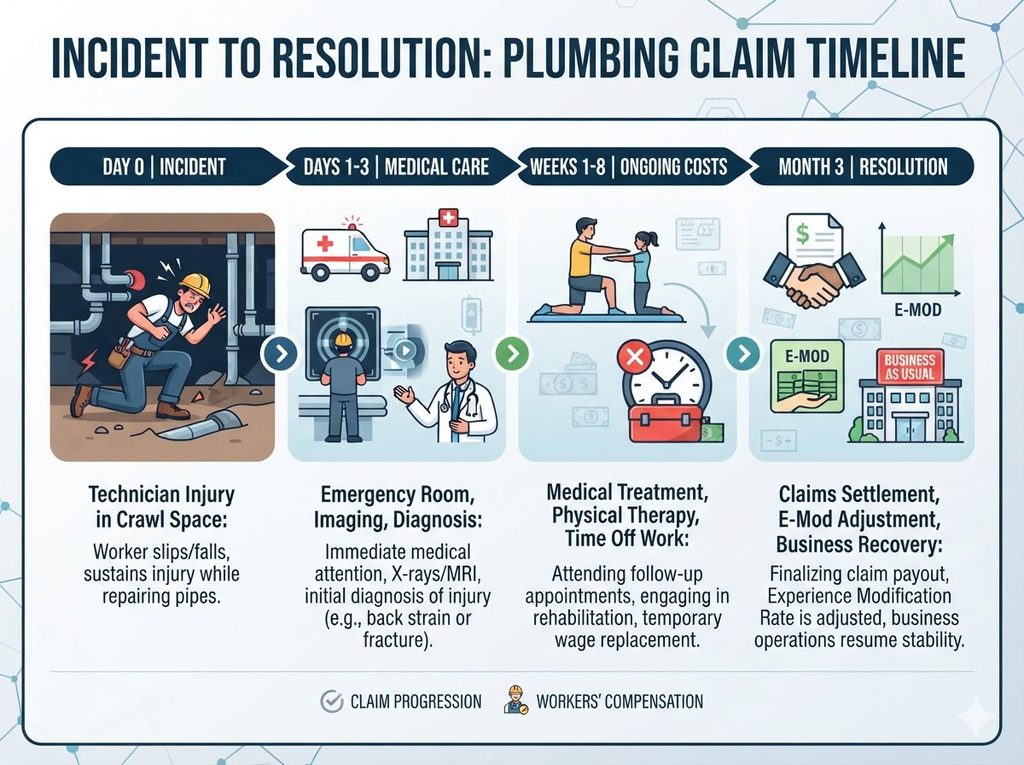
A residential plumbing contractor on the South Side runs a three-person crew. November. Cold snap. He gets called to a residential building with a burst pipe in a crawl space.
One technician works in a stooped position for an hour. Removing the frozen section. Accessing tight spots. Then—sharp pain in his lower back. He can’t straighten up.
Urgent care. MRI. Diagnosis: Herniated disc. Restrictions: No lifting over 10 pounds for six weeks. Physical therapy. Two months off work.
If he didn’t have workers’ comp:
The technician would sue him directly. Medical bills? Out of pocket—$8,000 for imaging and therapy. No paychecks for two months? That comes from the business. With two technicians left, he loses winter emergency calls—peak season for plumbing. Premiums skyrocket at renewal—20%+ increase for three years.
Total damage: Over $40,000 plus lost revenue.
If he had proper coverage:
Workers’ compensation covered everything. The carrier handled the claim. The technician got his wages while recovering. The e-mod adjustment at renewal? Modest. Around 1.05. The business stayed operational.
He also had commercial auto coverage because one technician had been hit earlier that year while parked at a customer’s home. That accident? Handled under the fleet policy. Not a personal claim.
Two separate incidents. Two separate programs. Business survives intact.
Certificates of Insurance: The Paperwork That Stops You From Working
Property managers and general contractors won’t let you start work without a Certificate of Insurance on file.
More than that? Many want it dated within 30 days. Some request updates monthly during long projects.
What does a COI prove? That you’re covered for workers’ comp, general liability, and commercial auto.
What happens without it? You’re off the job site. Mid-project. No exceptions.
What if it’s outdated? You’re shut down. That means the blocked toilet or leaking pipe sits unfixed while you scramble to get your insurance updated.
That’s a relationship killer.
Smart plumbers make this automatic:
First, ask your agent for same-day turnaround on certificates. Some carriers now offer self-service portals where you download them instantly.
Second, request a fresh COI before you think you’ll need it. Build a buffer into your workflow.
In Chicago’s competitive residential market, being the plumber who shows up with paperwork ready is the plumber who gets the repeat call.
See also: What Chicago HVAC contractors need to know about workers’ comp and auto coverage. The same certificate principles apply across trades.
Chicago plumber insurance FAQs
Is workers’ comp required for plumbers in Illinois?
Yes. Illinois requires workers’ comp for almost every employer with even one employee, full- or part-time. Skipping it exposes you to fines, stop-work orders, and lawsuits from injured workers.
What workers’ comp class code do plumbers use?
Most plumbing contractors fall under NCCI class code 5183 (Plumbing NOC and Drivers). Your premium is a rate per $100 of payroll in that code, adjusted by your e-mod. Office staff usually go under clerical code 8810, which costs far less.
Do I need commercial auto if my techs drive their own trucks?
Yes, in most cases. Hired and non-owned auto (HNOA) coverage protects you when employees use personal vehicles for work. If the business owns or leases vans, you need a commercial auto policy as well. Personal auto policies often exclude business use.
How much liability coverage do GCs require from plumbing subs?
Most ask for $1 million per occurrence and $2 million aggregate in general liability, plus $1 million in auto liability. Many also require additional insured status and a waiver of subrogation. Larger commercial jobs often add an umbrella.
Where can I get a Chicago plumber insurance quote?
An independent agency can compare several carriers at once. Have your payroll, vehicle list, and three years of loss history ready. Then call Weer Insurance Group at 773-545-2001 or request a quote online.
How Weer Insurance Group Helps Chicago Plumbers
We’ve spent years building partnerships with 30+ carriers that specialize in trades insurance.
We understand plumbing. We know back injuries and scalding are everyday hazards. We know winter ramps up your revenue and your exposure at the same time. We know Illinois law. And we know that a missing COI can cost you more than the insurance itself.
Whether you’re a solo technician adding your first helper or a growing firm managing multiple service trucks, we build a Chicago plumber insurance program that covers your workers, your fleet, and your reputation.
Ready to lock in your coverage before winter?
Contact us at 773-545-2001, request a quote online, or see our plumber insurance page. You can also learn more about us. Now is the time to make sure your paperwork is current and your coverage is solid.


