
 Click to Call
 Send us a Text
 Get Directions
Chicago contractor licensing insurance is the first thing the city checks, and it is the first thing that can sink an application. Illinois does not issue a statewide general contractor license. However, Chicago runs one of the most detailed licensing programs in the Midwest. Under Chapter 4-36 of the Municipal Code, general contractors hold a Class A through E license based on the size of the projects they take on.
In short, no insurance means no license. Below, we explain what the city expects, what changed in 2026, and how to avoid a costly lapse.
What Changed in 2026 for Chicago Contractor Licensing Insurance
On January 6, 2026, the Department of Buildings and its licensing partner, Continental Testing Services, updated the program. First, project limits for Class B, C, and D licenses doubled. Second, the general liability minimum for Class C and D licenses rose to $2 million per occurrence. Some older city summaries still show the previous $1 million figure, so always confirm the current number before you apply.
Also, fees rose for 2026 for the first time in years. As a result, a rejected application now costs you more time and more money.
Chicago Contractor Licensing Insurance Requirements by Class
The higher your license class, the more coverage the city wants. The chart below shows the minimum general liability limit per occurrence for each class.
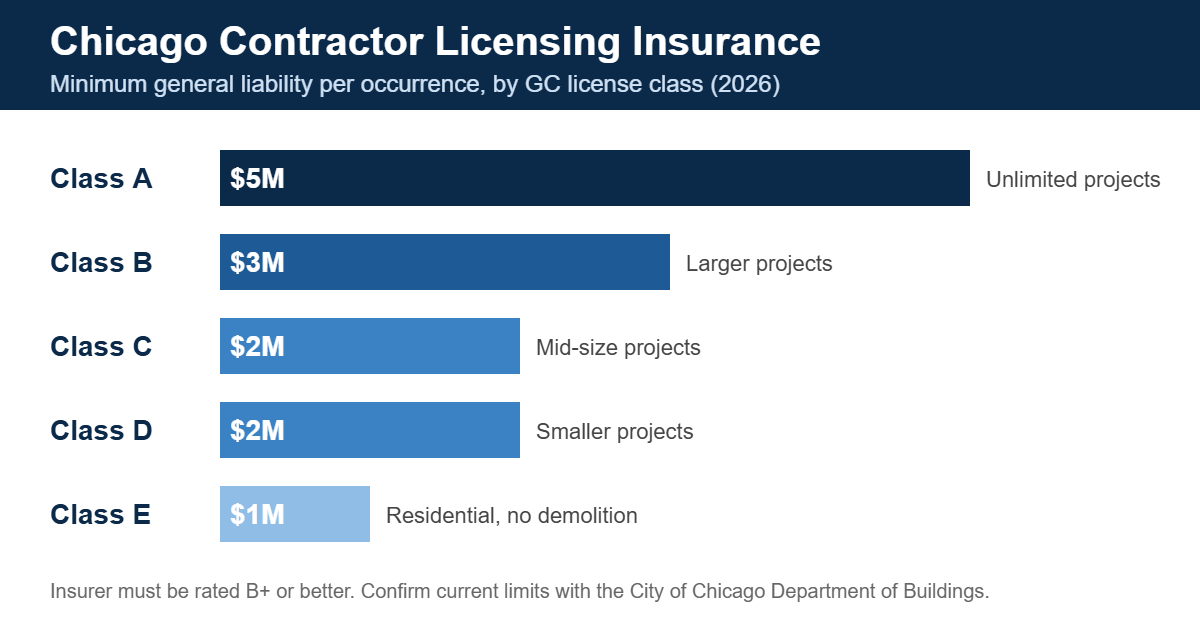
For example, a Class A contractor can bid on unlimited projects, but it needs $5 million per occurrence. Meanwhile, a Class E contractor works on smaller residential jobs with no demolition and needs $1 million. Class A and B limits can usually be met with a primary policy, an umbrella, or a combination of both.
What the City Looks for on Your Policy
Limits are only part of the picture for contractor licensing insurance in Chicago. In addition, the city reviews who issues the policy and how it is written.
- Carrier rating: The insurer must be authorized in Illinois and rated B+ or better by A.M. Best.
- Coverage scope: The commercial general liability policy should include bodily injury, property damage, and completed operations.
- Additional insured status: Many project owners and general contractors also require the City of Chicago or the owner on the certificate. In that case, ask for primary and non-contributory wording.
- Workers’ compensation: Illinois law generally requires it for contractors with employees. For details, see the Illinois Workers’ Compensation Commission.
- Correct certificate: The certificate of insurance (COI) must match the program’s holder and notice wording.
Why a Lapse in Contractor Licensing Insurance Can Shut Down Jobs
The city ties your license to your policy, so Chicago contractor licensing insurance must stay active. Therefore, when the policy on file expires, the license becomes inactive automatically. Because permits depend on an active license, work on permitted jobs can stop until you fix it.
To prevent that, send renewal proof to Continental Testing Services before your policy expires. Then, keep a copy of every certificate you submit. Finally, calendar your policy renewal date 60 days ahead so your agent has time to issue new paperwork.
How to Get Your Chicago Contractor Licensing Insurance Ready
- Confirm which license class fits your largest planned projects.
- Compare your current limits with the 2026 minimums for that class.
- Add an umbrella policy if you need higher limits for Class A or B.
- Ask your agent for a certificate formatted for the Chicago program.
- Submit proof with your application, and again at every renewal.
For the official class table and application steps, review the City of Chicago general contractor license page.
Chicago Contractor Licensing Insurance FAQs
Does Illinois require a state general contractor license?
No. Illinois does not issue a statewide general contractor license. However, Chicago requires its own license for general contractors, and other cities set their own rules.
What happens if my insurance expires?
The city automatically inactivates the license when the policy on file expires. As a result, you may not be able to pull permits until you submit proof of renewed coverage.
Do I need an umbrella policy for a Chicago contractor license?
It depends on your class. For Class A and B, the city accepts the required limit through a primary policy or umbrella. Because umbrella coverage for Chicago contractor licensing insurance is often cheaper than raising the primary limit, many contractors use it.
Can my agent issue the certificate for the city?
Yes. Your agent can issue a certificate with the correct holder and wording. Still, send it early so any corrections do not delay your application.
Get Help With Chicago Contractor Licensing Insurance
Weer Insurance Group in Chicago, IL helps contractors line up general contractor insurance that meets city requirements. Our post on workers’ comp and auto for Chicago plumbers covers related coverage. Policy terms vary, so request a quote or call 773-545-2001 to review your limits before you apply or renew.